

How Much Fabric Do You Actually Need?
One of the most common questions we get at the studio is some version of: "I want to make a dress; how many yards do I need?"
It is a simple question with a slightly complicated answer. It depends on the garment, your size, your tailor's cutting style, and whether you want to play it safe or cut it close. But the most overlooked factor? Fabric width.
Tampoori cotton is 44 inches wide. Rayon is 55 inches wide and sold as a complete 4.5-yard piece. That difference matters more than most buyers realise. On narrower fabric, you cannot always cut the front and back of a garment side by side. You have to cut them end to end, which eats more length. A dress that fits in 3 yards on 60-inch fabric may need 3.5 or 4 yards on 44-inch fabric.
This guide is written for a height of 5ft 4in (163cm) , with a UK 12 on top and UK 14/16 on the bottom; a very common fit for Ghanaian women, who often carry more of their shape through the hips and thighs. If that is not your exact size, use these figures as a starting point and adjust up if you are larger, taller, or want a more generous cut
The Fabric Before the Garment
Tampoori Cotton (44 inches wide)
Available in 3-yard and 4-yard pieces. We do not cut these lengths down. However, if you need something between the two, say 3.5 yards, WhatsApp us, because we sometimes have in-between pieces from the studio that we can sell as 3+ yard cuts.
Tampoori Rayon (55 inches wide)
Sold only as a complete piece: 55 inches wide and 4.5 yards long. No variations, no cutting. The good news is 4.5 yards on 55-inch fabric is genuinely generous for most garments, and the wider width makes A-line and flared silhouettes easier to cut.
Rayon is strictly for clothing. Its fluid drape is not suited to structured home furnishings, but it is beautiful for maxi dresses, wide-leg sets, and kaftans.
Three Technical Rules Every Buyer Should Know
Before we dive into specific garments, there are three technical factors that affect yardage. These are also factors your tailor considers but most buyers never think about.
1. The Grainline Rule
Your tailor always cuts with the grain, the direction of the fabric's threads. Cutting off-grain causes garments to twist and hang poorly. This means pattern pieces cannot be rotated arbitrarily to save space. They must align with the lengthwise grain, which affects how pieces fit on the bolt.
2. The One-Way Print Rule
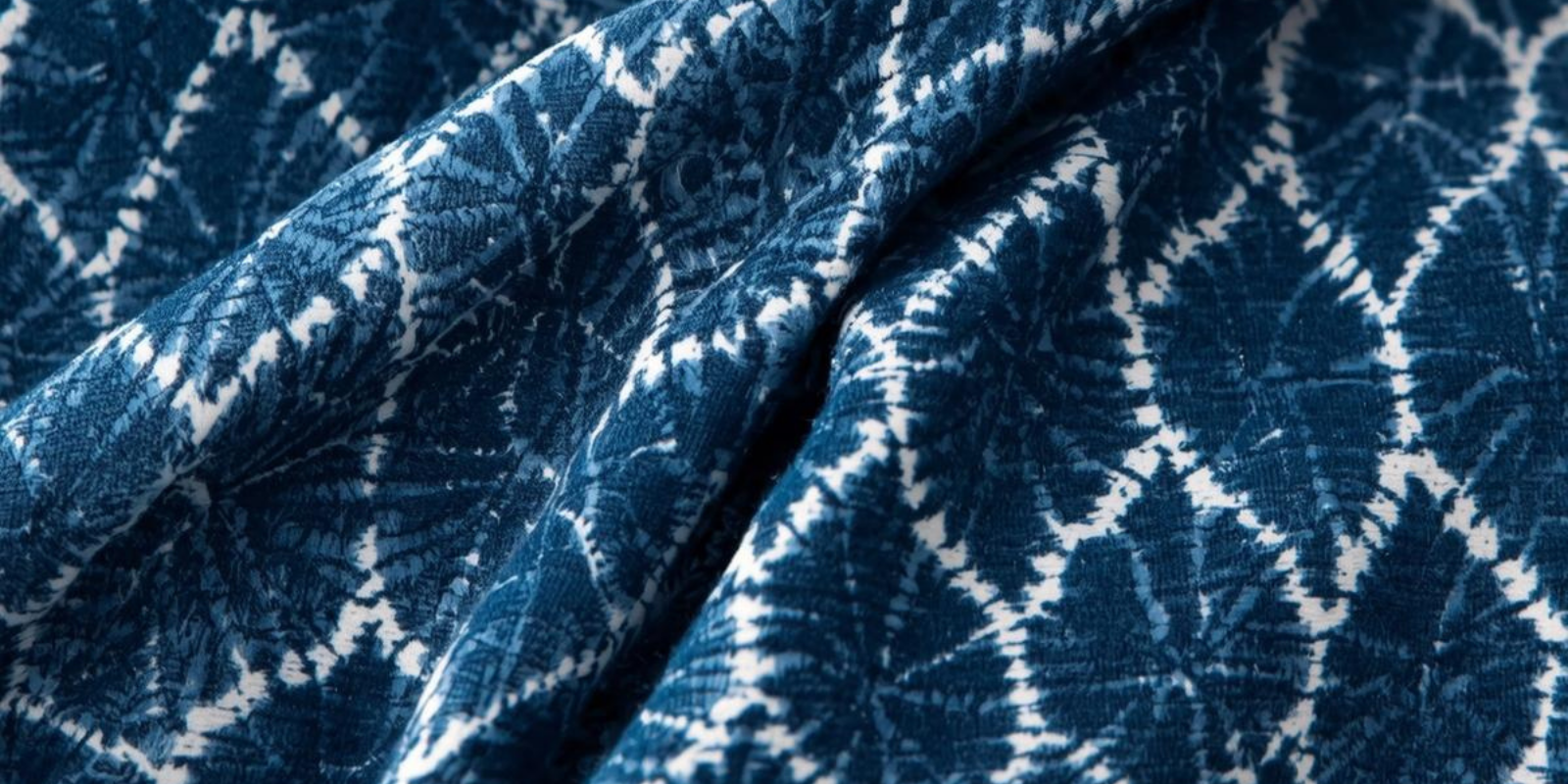
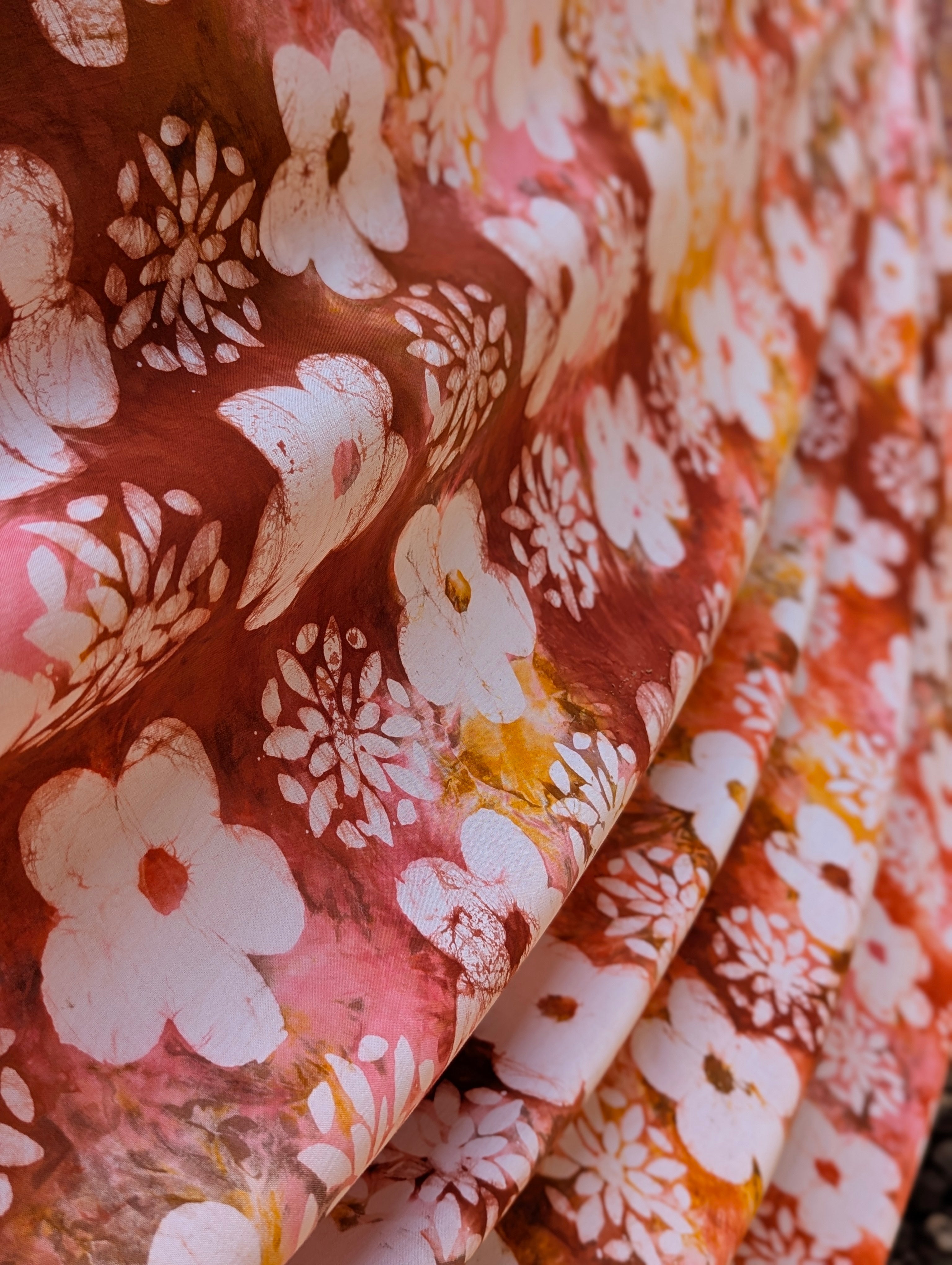
Tampoori fabrics are hand-dyed. Some patterns have a direction, that is, motifs that should face upward, like a repeated geometric shape or a directional tie-dye pattern. If your fabric is one-way, your tailor cannot flip pattern pieces upside down to nest them more efficiently. This can add 0.5 to 1 yard to your estimate.
Always check your fabric before assuming the lower yardage. If in doubt, show your tailor the print and ask if it is directional.
3. The Shrinkage Rule
100% cotton can shrink. A cautious tailor 5–10% for shrinkage allowance, especially for fitted garments. If you are cutting it close on yardage, consider adding a little extra for peace of mind.
Women's Wear: On 44-Inch Cotton
1. Wrap Skirt (midi or maxi length)
Recommended yardage: 1.5–2 yards
A wrap skirt is one of the most fabric-efficient garments you can make and one of the best showcases for a bold print. The wrap adjusts to your body, so sizing is forgiving. For a midi-length wrap at UK 14/16 hips, 1.5 yards is enough. For a maxi-length wrap, go to 2 yards.
Since our smallest cotton piece is 3 yards, you will have leftover fabric. Use it for a matching top or save it for a future project.
Buy: 3 yards (and make it a set).
2. Pencil Skirt (knee-length or midi)
Recommended yardage: 1.5–2 yards
A pencil skirt is one of the most efficient uses of fabric. At UK 14/16 hips, a knee-length pencil skirt rarely needs more than 1.5 yards. Midi length takes you closer to 2 yards.
The challenge is that 2 yards is less than our smallest piece. The good news? A 3-yard piece gives you enough for a pencil skirt plus a fitted top in the same print. We call this the Tampoori Power Suit, a sleek pencil skirt and matching top cut from one piece of hand-dyed fabric. It is one of the most striking things you can walk into a room wearing.
Tailor's note: 3 yards works for a sleeveless or cropped top with a pencil skirt. If you want long sleeves or a longer hip-length top, buy 3.5 yards.
Buy: 3 yards for sleeveless/cropped, 3.5 yards for long sleeves.
3. Midi Dress (fitted bodice, straight cut)
Recommended yardage: 3–3.5 yards
A fitted midi dress with a straight or slightly A-line skirt is one of the most popular styles made with Tampoori fabric. For a UK 12/14 with fuller hips, 3 yards will work for a simple, sleeveless silhouette. If the dress has sleeves, add half a yard.
Buy: Ask us about a 3+ yard piece first. If we do not have one, 4 yards gives you breathing room.
4. Midi Dress (A-line or circle skirt)
Recommended yardage: 4 yards, non-negotiable
If your tailor is cutting on the bias or making a true circle skirt, 4 yards is not a suggestion; it is a requirement. Bias cutting uses significantly more fabric because of the angle, and you cannot add yardage mid-cut. The swirl and movement of tie-dye looks beautiful in a skirt cut this way, but it demands the full length.
Buy: 4 yards.
5. Maxi Dress (straight or fitted)
Recommended yardage: 4–4.5 yards
A floor-length dress needs more fabric than people expect. At 5ft 4in with a fuller lower half, the shoulder-to-floor measurement is what drives yardage here. The bodice and skirt are often cut as one piece, meaning your full height is the baseline before you add seam allowances, hems, and sleeves.
A simple, straight maxi can be done in 4 yards for a sleeveless version. If you want sleeves, gathering, a wraparound style, or built-in lining, you need 4.5 yards.
Buy: 4 yards for sleeveless, 4.5 yards for sleeves or details. Ask us about a 4+ yard piece if your tailor recommends extra.
6. Maxi Dress (flared or fuller skirt)
Recommended yardage: 5 yards
For a dramatic, full-skirted maxi, 4 yards will run short. This is the one dress length where we recommend a conversation with your tailor before you buy.
Buy: Ask us about a 4+ yard piece. We sometimes have lengths that sit between 4 and 5 yards.
7. Kaba and Slit
Recommended yardage: 4.5–5 yards
A tailor knows that kaba and slit is essentially two garments:
-
The kaba requires its own layout, roughly 1.5–2 yards depending on sleeve length.
-
The slit requires a full panel length, usually 2.5–3 yards to achieve the wrap and train.
These pieces cannot be nested efficiently because the grainlines run in different directions. At UK 14/16 hips, a traditional kaba and slit requires 4.5 to 5 yards to allow for a full, flowing wrap that sits comfortably and allows for walking ease.
This is the one garment where we always recommend a conversation with your tailor before you buy. Come into the studio or WhatsApp us with your tailor's request.
Buy: Ask us about a 4+ or 5-yard piece.
8. Blouse and Skirt Set (Co-ord)
Recommended yardage: 3.5–4 yards
A co-ord set, matching top and skirt cut from the same fabric, is one of the most popular ways to use Tampoori fabric. When the fabric is this distinctive, having the full look in the same print makes a real statement.
For a crop or fitted top plus a midi skirt at UK 12 on top and UK 14/16 on the bottom, you need around 3.5 yards. Two separate pieces from one bolt means more planning in the cut; your tailor needs room to lay the pieces without compromising the grain line. If the skirt is fuller or longer, or if the top has sleeves, move to 4 yards.
Buy: Ask us about a 3+ yard piece first. If we do not have one, 4 yards gives you the room to work with.
9. Wrap Blouse or Relaxed Top
Recommended yardage:
-
Short sleeves or sleeveless: 1.5–2 yards
-
Long sleeves or dramatic sleeves: 2–2.5 yards
A simple wrap blouse or boxy oversized top at UK 12 can be made comfortably in 1.5 yards if it is sleeveless. Long, flowing sleeves — common with Tampoori fabric — eat more yardage because two long sleeves cut on the grain take up length.
Like the pencil skirt, this means a 3-yard piece will leave you with fabric to spare — which most of our customers are very happy about.
Buy: 3 yards and pair it with a skirt or trousers from the same piece for a co-ord, or save the rest for a future project.
10. Kaftan (standard, with or without sleeves)
Recommended yardage: 3–3.5 yards
A kaftan is one of the most forgiving garments to make and one of the best showcases for bold, hand-dyed fabric. The loose silhouette means sizing is flexible, but the length and width of a full kaftan still requires a decent amount of fabric. At 5ft 4in, a full-length kaftan with sleeves needs around 3.5 yards. Without sleeves, 3 yards is usually enough.
Buy: Ask us about a 3+ yard piece.
11. Kaftan (butterfly style; sleeves cut from the body)
Recommended yardage: 4 yards
The butterfly kaftan folds the fabric over itself widthwise, with the fold becoming the shoulder line. This means:
-
Folded width = 22 inches (half of 44")
-
The sleeve length + body width must fit within that 22 inches from fold to selvedge
For a UK 14–16, 22 inches is usually enough. However, if you have broader shoulders or longer arms, 4 yards on 44-inch fabric may still produce a kaftan with slightly short sleeves. If this is a concern, consider sizing up to 4.5 yards or choosing the rayon option for the extra width.
Buy: 4 yards (or 4.5 if you have broader shoulders).
Women's Wear: On 55-Inch Rayon
Rayon comes as one piece: 55 inches wide, 4.5 yards long. The wider width and generous length mean most garments work within this single piece. However, rayon is slippery and shifts during cutting. Some patterns that require precise grain matching may still need careful handling, so do not try to squeeze a fifth garment out of the piece.
Here is what 4.5 yards of 55-inch rayon comfortably makes:
-
A full maxi dress with room to spare
-
A wide-leg trouser and blouse set
-
A generous kaftan (including butterfly style)
-
A midi dress plus a matching wrap
-
A co-ord set with leftover fabric for accessories
The wider width also helps with A-line and flared silhouettes — you can sometimes cut pieces side by side that would have to go end to end on 44-inch cotton.
Men's Wear: On 44-Inch Cotton
1. Shorts and Shirt Set
Recommended yardage: 3–3.5 yards
Shorts are short, which creates room to cut both pieces from the same length with careful planning. A 3-yard piece works for a standard set. Go to 3.5 yards for a looser fit or longer shorts.
Buy: 3 yards, or ask about a 3+ piece for extra room.
2. Shirt Only (Short Sleeve or Long Sleeve, Loose Fit, Below Waist)
Recommended yardage: 2.5–3 yards
A standalone shirt, whether short sleeve or long sleeve, is a common request for customers who already have trousers or want to mix and match later. At 44 inches wide, a loose-fitting shirt that hits below the waist requires careful layout.
-
Short sleeve: 2.5 yards is sufficient for most standard sizes (chest 40–42). The shorter sleeves allow the tailor to cut the body and sleeves within the same length without much waste.
-
Long sleeve: 3 yards is the safe minimum. Long sleeves must run lengthwise on 44-inch fabric, which adds to the total needed. If the customer is tall or wants a very generous cut, go to 3.5 yards.
Buy: 2.5 yards for short sleeves (ask about a 2+ piece if available), 3 yards for long sleeves.
3. Trousers Only (Standard Fit, Full Length)
Recommended yardage: 2–2.5 yards
A pair of standard-fit, full-length trousers at UK 14–16 equivalent (men's waist 34–36) typically needs 2 yards on 44-inch fabric. This assumes the legs are cut efficiently and there is no extreme flare or wide-leg style.
-
Standard fit: 2 yards works if the tailor cuts both legs side by side within the width.
-
Relaxed or slightly wider leg: 2.5 yards gives room to manoeuvre, especially if the customer has larger thighs or prefers a looser silhouette.
If the trousers are for a larger waist size (38+) or if the customer wants a very wide leg (like palazzo-style for men), move up to 3 yards.
Buy: 2 yards for standard fit, 2.5 yards for relaxed fit. Ask your tailor first if you are unsure.
4. Men's Kaftan Set
Recommended yardage: 4–5 yards
In Ghana, a men's kaftan is almost always purchased and worn as a set, meaning a matching pair of trousers and a shirt. The shirt is typically cut loose, hits below the waist, and can be made with either short sleeves or long sleeves. Collar styles vary: some customers prefer a mandarin collar with a shoulder zip (a clean, modern finish), while others opt for a short classic collar.
-
4 yards: Short Sleeve Kaftan Set (Trousers + Short Sleeve Shirt)
The shirt is loose-fitting and falls below the waist, which adds length. Combined with a full pair of trousers, 4 yards is the safe minimum for a standard fit (chest 40–42). If the customer has a larger build or wants an especially generous cut, go to 4.5 yards. -
4.5-5 yards: Long Sleeve Kaftan Set (Trousers + Long Sleeve Shirt)
Long sleeves add significant length to the layout. At 44 inches wide, the sleeves cannot always be cut sideways; they may need to run lengthwise, eating into the same yardage as the shirt body and trousers. 4.5 yards is the realistic minimum. For very full sleeves or a taller frame, 5 yards is safer.
Buy: 4-5 yards depending on the vision.
5. Agbada
Recommended yardage: 8–10 yards
This is the number that most guides get badly wrong. The agbada is not a small garment. The flowing gown alone requires massive width and length, and at 44 inches wide you cannot achieve the proper billowing sleeves and wide body without buying double what you might expect.
8 yards is the absolute minimum for a traditional agbada. If you want very full sleeves, buy 10 yards.
Buy: 8–10 yards. Do not gamble on less.
A Quick Reference (Cotton, 44-Inch Width)
| Garment | Yardage Needed | What to Buy |
|---|---|---|
| Wrap skirt (midi/maxi) | 1.5–2 yards | 3 yards (use the rest) |
| Pencil skirt + top (sleeveless/cropped) | 2.5–3 yards | 3 yards |
| Pencil skirt + top (long sleeves) | 3–3.5 yards | 3.5 yards or ask for 3+ |
| Midi dress (straight, sleeveless) | 3 yards | Ask for 3+ |
| Midi dress (with sleeves) | 3.5 yards | Ask for 3+ or buy 4 |
| Midi dress (circle skirt/bias) | 4 yards | 4 yards |
| Maxi dress (straight, sleeveless) | 4 yards | 4 yards or ask for 4+ |
| Maxi dress (with sleeves) | 4.5 yards | Ask for 4+ |
| Maxi dress (flared) | 5 yards | Ask for 4+ |
| Kaba and slit | 4.5–5 yards | Ask for 4+ or 5 |
| Co-ord set (top + midi skirt) | 3.5–4 yards | Ask for 3+ or buy 4 |
| Wrap blouse (sleeveless/short sleeves) | 1.5–2 yards | 3 yards (use the rest) |
| Wrap blouse (long sleeves) | 2–2.5 yards | 3 yards (use the rest) |
| Kaftan (standard) | 3–3.5 yards | Ask for 3+ |
| Kaftan (butterfly) | 4 yards | 4 yards |
One Last Thing
Every tailor cuts differently. Some are generous cutters who like extra fabric to work with. Some are precise and efficient. Some patterns require more fabric than others even for the same garment. The figures in this guide are solid starting points, but your tailor knows your body and your pattern better than we do.
Before you buy, show your tailor the fabric width (Tampoori fabric is 44–45 inches wide) and describe or sketch the garment you want. Ask them directly: how many yards do you need? Then come to us with that number and we'll tell you whether a 3-yard or 4-yard piece works or whether you need to ask about one of our in-between pieces.
You can reach us on WhatsApp or pop into either studio and we'll help you figure it out.
Browse our fabric collections at tampoori.com or visit us in Accra:
Spintex Road · Open Mon–Sat, 9am–6pm
Labone Crescent · Open Mon–Sat, 10am–7pm

Leave a comment
This site is protected by hCaptcha and the hCaptcha Privacy Policy and Terms of Service apply.